
June 25, 2026
5 Mistakes to Avoid When Starting a Business in Saudi Arabia
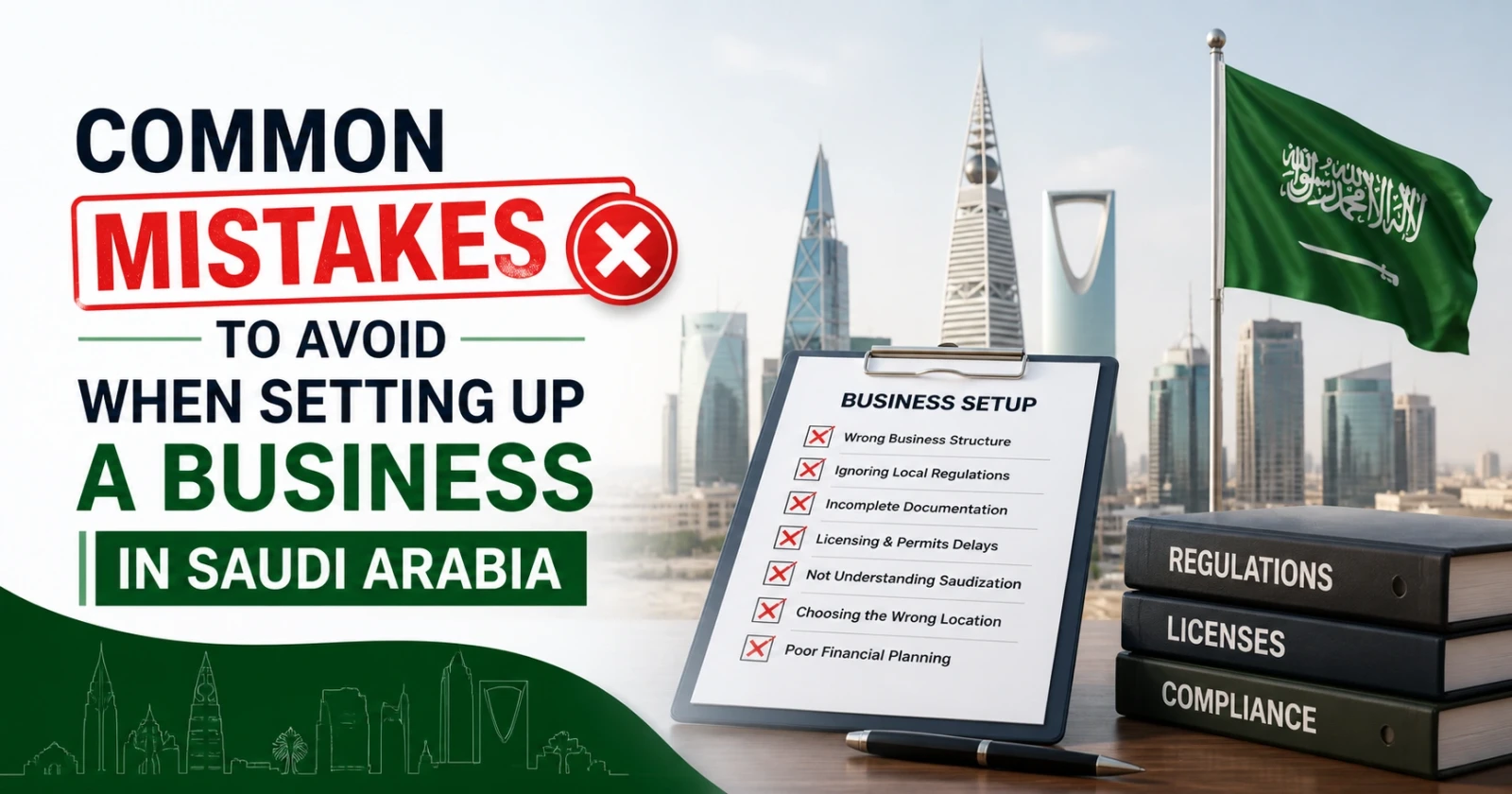
For decades, Indians built Saudi Arabia’s backbone—from healthcare pioneers to retail empires, from IT innovators to hospitality leaders. Yet many Indian entrepreneurs still approach the Kingdom with outdated playbooks, legacy practices that worked in the 1990s but are now illegal, costly, and unnecessary. The Saudi Arabia of 2026 is not your father’s business landscape. Vision 2030 is no longer a roadmap—it’s a transformed reality. 100% foreign ownership is now the default in most sectors, not the exception. Digital tax systems are real-time and unforgiving. Anti-concealment laws carry prison sentences of up to five years and fines reaching SR5 million (approximately USD 1.3 million). And the relational business culture—the legendary wasta—still matters enormously, but it must coexist with ruthless legal compliance, not replace it.
The good news? Saudi Arabia’s government has never been more welcoming to Indian capital, Indian talent, and Indian vision. 476 Indian companies now operate in the Kingdom with registered investments worth USD 1.5 billion. Major business houses like Lulu Group International, Al Abeer Healthcare, and Jeddah National Hospital have become household names. The infrastructure, the regulations, and the economic incentives are better than ever. But the margin for error has also shrunk. One mistake during setup can undo months of planning and capital. This guide cuts through the noise and reveals the five critical mistakes even seasoned Indian entrepreneurs are making in 2026—and exactly how to avoid them.
If you’re thinking of hiring a local Saudi as a “silent partner” to front your business while you control it behind the scenes, stop. This informal arrangement—known as Tasattur (commercial concealment)—is no longer a grey area in Saudi Arabia. It is explicitly, aggressively illegal, and the penalties are severe.
The allure is understandable. For generations, the Saudi sponsorship system required a local partner. Many Indian entrepreneurs in the UAE, Kuwait, and Bahrain still operate under similar arrangements. So the instinct is: hire a respected Saudi, put their name on the documents, pay them a monthly stipend, and run the business yourself. Quick, simple, familiar. It’s also a felony.
Under the Anti-Commercial Concealment Law, penalties for both the Saudi “concealer” and the non-Saudi “concealed” include:
Imprisonment: Up to 5 years
Financial fine: Up to SR5 million (approx. USD 1.3 million)
Confiscation of all illegal funds acquired through the concealed business
Deportation (for non-Saudis): Immediate expulsion after serving the sentence
Permanent re-entry ban: Barred from working in the Kingdom indefinitely
Liquidation of the business: All operations shut down and assets seized
Moreover, if you dispose of a facility, grant signing authority to a non-Saudi individual without proper documentation, or operate under an individual employment visa (such as a household worker or driver visa) for commercial purposes, you are committing Tasattur. The Saudi government isn’t looking the other way—it’s actively hunting. In 2025 alone, authorities detected over 1,000 suspected commercial concealment cases and imposed millions in fines.
Here’s what most Indian entrepreneurs don’t realize: you don’t need a Saudi partner anymore. As of January 2026, the Ministry of Investment Saudi Arabia (MISA) allows 100% foreign ownership in most sectors, including manufacturing, software development, transportation, healthcare, and professional services.
The MISA license is your legal shield. It costs far less than a concealment arrangement (no ongoing bribes disguised as “management fees”), takes 2–4 weeks to process, and grants you absolute legal standing. You’re not hiding. You’re not exposed. You’re operating as a legitimate foreign investor under Saudi law, with all the protections that entails.
The process is straightforward:
Identify your business activity (and confirm it allows 100% foreign ownership).
Prepare and legalise your corporate documents (translated into Arabic).
Submit your application via the MISA e-portal.
Receive your Foreign Investment License.
Proceed with company incorporation.
For Indian entrepreneurs, this is transformative. You can own your business outright, make unilateral decisions, repatriate profits, and build a long-term enterprise without the existential risk of a silent partner turning hostile or the government discovering your arrangement. The old informal way was cheaper upfront. The legal way is infinitely safer and ultimately cheaper overall.
If you’ve built a business in the UAE or Bahrain, you may think Saudization (the Nitaqat program) is just another compliance checkbox. It’s not. The Saudi approach is far more stringent, more systematically enforced, and more strategically important than other GCC jurisdictions.
Saudi Arabia’s Nitaqat program mandates that companies hire a specific percentage of Saudi nationals based on company size and industry sector. Unlike the UAE’s looser approach, Saudi’s system is tied to government tenders, visa allocations, commercial registration renewals, and Ministry of Labor services. Get it wrong, and you don’t just face a fine—you lose access to the government contracts that often sustain mid-market businesses.
The quotas vary significantly by sector and have been increasing throughout 2025–2026. Here’s what you need to know:
Accounting firms with at least 5 accountants must meet a 40% Saudization rate, effective October 2025, with annual increases of 10% until 2028.cercli
Engineering firms with 5 or more engineers must achieve 30% Saudization starting July 2025.
Dentistry clinics with 3 or more dental professionals must meet 45% Saudization from July 2025, rising to 55% by January 2026.
General sectors follow these baseline rules:
Small companies (up to 5 employees): Minimum 1 Saudi national
Medium companies (6–100 employees): Varies by sector
Large companies (100+ employees): Minimum 30% Saudization rate
The classification system works in tiers. Platinum companies achieve the highest Saudization levels and receive priority access to government services and visa allocations. High Green companies meet the required targets and can apply for new work visas. Non-compliant companies face fines, visa freezes, and exclusion from government projects.
Here’s the insight many Indian entrepreneurs miss: Saudization isn’t an obstacle. It’s an opportunity to build a sustainable local team. The top Indian-run businesses in Saudi Arabia—Lulu Group, Al Abeer Healthcare, Jeddah National Hospital—succeeded partly because they invested in Saudi talent early and systematically.
Hiring Saudi nationals gives you:
Cultural credibility: Local staff understand consumer preferences, bureaucratic nuances, and relationship dynamics that foreigners miss.
Government goodwill: Compliance demonstrates long-term commitment and opens doors to contracts and regulatory favors.
Operational stability: Saudi employees reduce visa-related HR risks and provide continuity.
The mistake isn’t Saudization itself. It’s treating it as a last-minute compliance task rather than a foundational hiring strategy. Start recruiting Saudi talent from month one. Budget for their salaries and training. Partner with local recruitment firms. Build your quota into your financial projections, not as an afterthought.
A common mistake: Indian entrepreneurs who’ve succeeded in the UAE assume Saudi Arabia operates on the same business logic. It doesn’t. Dubai’s culture is transactional, fast, and relationship-light compared to Saudi Arabia’s deeper, more hierarchical, and relationship-intensive business environment.
In Dubai, you can walk into a networking event, exchange WhatsApp numbers with a CEO, and close a deal via email within a week. In Saudi Arabia, that same scenario could take three months—but once the relationship is established, you’ll have a partner for decades. The cultural difference is profound, and ignoring it is one of the costliest mistakes Indian entrepreneurs make.
Central to Saudi business culture is wasta—a term often translated as “connections” or “influence,” but it means far more. Wasta is rooted in tribal traditions and represents a complex social and professional currency based on trust, loyalty, and mutual obligation.
Unlike formal Western systems that emphasize contracts and documentation, wasta often works in parallel to formal procedures. A trusted connection can expedite a municipal approval, facilitate an introduction to a decision-maker, or smooth a negotiation that might otherwise stall. This doesn’t mean bribery or corruption—it means that personal relationships, family networks, and trusted intermediaries carry weight in ways that a foreign entrepreneur must understand and respect.
For Indian entrepreneurs, the challenge is this: You cannot build wasta remotely. You cannot establish it via LinkedIn or email. It requires physical presence, face-to-face meetings, patient relationship building, and a willingness to prioritize personal connection before business transaction.
If you’re serious about Saudi Arabia, consider the Regional Headquarters (RHQ) Program. Over 600 multinational companies have committed to establishing regional headquarters in Riyadh as of 2026, making this one of the most significant strategic shifts in Middle Eastern business.
The RHQ program offers extraordinary incentives:
10-year exemption from Saudization quotas: Allows you to hire global talent without the normal 30% Saudi headcount requirement.
Large visa quotas from day one: Simplifies expat recruitment and family reunification.
Work permits for spouses: Reduces family relocation friction.
Waived professional accreditation: Many expat roles don’t require Saudi licensing.
Expatriate flexibility: Ability to relocate global experts without bureaucratic delays.
To qualify, your company must operate in at least two countries in the region and commit to maintaining a physical office in Riyadh with a resident executive director, minimum 15 employees (including 3 executives), and separate accounting records.
For an Indian entrepreneur with offices in India and plans for the GCC, establishing an RHQ in Riyadh is a strategic accelerator. It signals long-term commitment, grants visa and HR flexibility, and positions you as a serious regional player—all of which strengthen your wasta and stakeholder relationships.
The bottom line: You must be present. Not every month, but certainly every quarter. Schedule regular trips to Riyadh and/or Jeddah. Meet with partners, government officials, and clients in person. Participate in local business associations. Attend sector-specific forums. This physical presence builds trust and accelerates relationship formation in ways that remote management simply cannot.
Dubai-style business can work remotely. Saudi Arabia cannot. Factor travel and presence costs into your budget from the start.
Many Indian entrepreneurs carry a “fix the books later” mentality from South Asia, where tax authorities are overburdened and enforcement is inconsistent. This mindset is lethal in Saudi Arabia. As of 2026, the Kingdom operates one of the most sophisticated, digitized, and aggressively enforced tax systems in the Middle East, managed by the Zakat, Tax and Customs Authority (ZATCA).
ZATCA’s e-invoicing system (FATOORA) is now fully operational and mandatory. Every transaction is recorded in real-time, validated against a digital signature, and submitted to ZATCA’s servers. Non-compliance is detected instantly. Audits are automated. Penalties are automatic.
ZATCA has rolled out e-invoicing in waves based on annual VAT-subjected revenues.
Wave 24 (announced in 2025) requires VAT-registered businesses with annual turnover exceeding SAR 375,000 (approximately USD 100,000) to integrate their e-invoicing solutions with ZATCA’s Fatoora Portal by June 30, 2026.
If your business exceeds these thresholds, you cannot issue handwritten invoices, Excel-based invoices, or invoices without a digital signature and QR code. Every invoice must be:
Generated through a ZATCA-compliant e-invoicing solution
Encoded with a machine-readable XML format
Embedded with a cryptographic timestamp
Submitted for real-time validation before issuance
Simplified invoices (for B2C transactions under SAR 1,000) must be reported to ZATCA within 24 hours.
The cost of non-compliance is steep:
Non-issuance of e-invoices: Fines starting at SR 5,000 (approx. USD 1,300)
Missing QR codes or tax registration numbers: Initial warning; repeated violations incur fines
Deleting or amending e-invoices after issuance: Fines of SR 10,000 (approx. USD 2,700)
System integration delays: Fines escalate with each wave deadline missed
Importantly, ZATCA has extended a six-month grace period through June 2026, during which penalty exemption initiatives remain active for taxpayers who meet specific conditions (submission of outstanding VAT returns, payment of principal tax dues, and active registration under applicable tax laws). However, once this grace period ends, compliance becomes mandatory without exceptions.
Here’s what Indian entrepreneurs must do:
Register for VAT immediately upon company formation (if you exceed the registration threshold). Don’t delay hoping to stay below the threshold—ZATCA will eventually catch you.
Choose a ZATCA-compliant e-invoicing solution from day one. Do not use generic accounting software. Platforms must be specifically certified by ZATCA. (ZATCA publishes a list of approved providers on its website.)
Integrate with the Fatoora Portal before your wave deadline. There is no extension beyond the deadline. Missing it means automatic fines and potential business shutdown.
Maintain clean, real-time financial records. Your books must match your ZATCA submissions exactly. Any discrepancy triggers an audit.
Budget for professional compliance support. A local accountant or tax consultant familiar with ZATCA requirements is not optional—it’s essential.
Indian entrepreneurs often underestimate ZATCA because they’re accustomed to loosely-enforced tax regimes at home. Saudi Arabia is different. The tax authority has teeth, and it uses them.
The final mistake is equally subtle and costly: misunderstanding the relationship between personal trust (wasta) and contractual obligation in Saudi business.
Many Indian entrepreneurs assume that once they have a signed contract, the relationship is locked in place and can operate on pure business logic. Others swing to the opposite extreme, believing that wasta supersedes contracts and that a verbal commitment from a trusted partner is sufficient. Both approaches will fail.
In Saudi Arabia, contracts are essential, but wasta determines how fast they get executed. A signed contract with a government agency might take six months to be actioned if you have no relationship with the procurement officer. The same contract, backed by an introduction from a respected intermediary, might be executed in four weeks.
Here’s the framework:
Contracts define the terms, protect your legal rights, ensure compliance with government regulations, and create a dispute resolution mechanism if things go wrong. They are non-negotiable.
Wasta* determines the pace, smooths bureaucratic friction, opens doors to decision-makers, and builds the goodwill that turns a transactional relationship into a partnership.
The error: Thinking that aggressive negotiation, price-cutting, or legal threats will accelerate deals. In Saudi business culture, this approach destroys relationships and slows everything down. A person who hammers a supplier on price or uses contract clauses to extract concessions is seen as untrustworthy and transactional.
The correct approach: Invest time upfront in building relationships. Be generous in early dealings—don’t squeeze every penny on the first contract. Introduce yourself and your family to your partners, not just your business. Share meals, attend social events, and show genuine interest in their success. Then, once trust is established, you can negotiate firmly and enforce contracts, because the relationship cushions the friction.
If you’re new to Saudi Arabia, here’s how to build wasta strategically:
Tier 1 (Foundation): Hire a respected Saudi business consultant or lawyer who has deep connections. This person becomes your gateway and introduces you to Tier 2 contacts.
Tier 2 (Primary Network): Government officials, Chamber of Commerce members, sector leaders. Meet them in person. Attend their events. Ask for their advice.
Tier 3 (Extended Network): Their friends, relatives, and business associates. Word of mouth travels fast in Saudi networks. A positive reputation compounds.
Tier 4 (Institutional): Once you’ve been operating for 12–24 months, formal associations, government committees, and industry bodies. By this point, your reputation precedes you.
The entire pyramid is built on showing respect, being reliable, delivering on promises, and prioritizing relationships over immediate profit. For Indian entrepreneurs accustomed to arm’s-length B2B transactions, this requires a mindset shift.
When negotiating in Saudi Arabia:
Never be the first to propose your bottom line. Let the other party show their position first.
Avoid aggressive language or ultimatums. Phrases like “take it or leave it” are seen as disrespectful.
Frame negotiations as mutual problem-solving, not competitive positioning. “How can we structure this so both sides benefit?” works far better than “Here’s my price; accept or reject.”
Expect the process to be slower than in India or the UAE. Multiple meetings, consultations with advisors, and family discussions are normal. Pressure is counterproductive.
Build in buffer time on timelines. If a deal “should” take 2 months, budget for 3–4 to account for relationship-building and bureaucratic processes.
Now that you understand the five mistakes, here’s a concrete action plan for your Saudi Arabia launch in 2026:
Verify 100% ownership eligibility. Confirm that your business sector allows full foreign ownership under MISA. If not, identify which sectors do align with your expertise.
Prepare documentation. Gather your Indian company’s articles of association, financial statements, certificate of incorporation, and board resolutions. Have them notarized and ready for attestation at the Saudi Embassy in India.
Attest financial statements. Submit your Indian company’s last 1–2 years of audited financial statements to the Saudi Embassy or Consulate in India for official attestation. This typically takes 2–3 weeks.
Hire a local business consultant. Engage a Saudi Arabia-based company formation or business setup specialist. This investment (typically SR 5,000–15,000 or USD 1,300–4,000) will save you months and tens of thousands in mistakes.
Prepare MISA license application. Work with your consultant to draft a comprehensive business plan, identify your specific business activity code, and determine capital requirements.
Translate documents into Arabic. All corporate documents must be officially translated into Arabic. Use a MISA-approved translation service.
Submit via MISA e-portal. Lodge your application for the Foreign Investment License through the Ministry of Investment’s online portal.
Await approval. MISA typically approves within 2–3 weeks. Your consultant will follow up and keep you informed.
Establish company with Ministry of Commerce. Once your MISA license is approved, proceed with formal company incorporation with the Ministry of Commerce and Investment to obtain your Commercial Registration (CR) certificate.
Open a corporate bank account. Present your MISA license, CR, and attestation documents to a Saudi bank (e.g., Riyad Bank, Al Rajhi Bank) to open a business account.
Register with ZATCA. Obtain a unified tax number and register for VAT if applicable. Immediately select and integrate with a ZATCA-compliant e-invoicing platform.
Initiate Saudization planning. Identify Saudi recruitment firms and begin recruiting for your Saudization quota. Plan salary budgets and training programs.
Secure sector-specific licenses. Depending on your industry (healthcare, education, logistics, etc.), obtain necessary sector licenses from relevant ministries.
Establish regional relationships. Schedule your first trip to Saudi Arabia to meet with government contacts, Chamber of Commerce officials, and industry partners introduced by your consultant.
Finalize hiring and onboarding. Hire your core team, including Saudi nationals to meet Saudization requirements.
Comply with e-invoicing. Go live with your ZATCA-compliant invoicing system. Test it thoroughly before your first transaction.
Schedule quarterly visits. Block your calendar for quarterly trips to Riyadh or Jeddah to maintain relationships and oversee operations.
The historic relationship between India and Saudi Arabia is at an inflection point. For the first time, Indian entrepreneurs can tap into a kingdom of 37 million people, USD 1 trillion in GDP, and unparalleled government support for private investment and economic diversification. The barriers that existed in previous decades—mandatory local partners, opaque regulations, bureaucratic delays—are crumbling.
But this opportunity comes with a catch: the rules are now clear, and the enforcement is ruthless. The old informal practices—silent sponsors, cash-based accounting, relationship-based shortcuts—are criminal offenses in 2026. The entrepreneurs who thrive will be those who respect this new reality, embrace legal compliance as a competitive advantage, and recognize that building sustainable businesses in Saudi Arabia requires equal parts legal rigor and relationship investment.
The vision is clear. The opportunity is real. The framework is in place. All that stands between you and a thriving business in Saudi Arabia is understanding these five mistakes—and having the discipline to avoid them.
Your moment is now. Use it wisely.